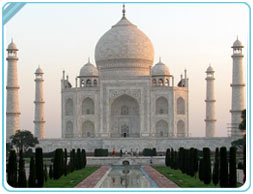
 Taj Mahal was constructed between 1631 A.D and 1654 A.D. The construction is said to have been done by a workforce of 22,000 that contained among others laborers, Naqqashi laborers, painters, stonecutters, garden-layers, gardeners, embroidery artists and masons. The Mughal Emperor Shah Jahan commissioned its construction. It was constructed as a mausoleum for Arjumand Begum, who was re-christened Mumtaz after her marriage to Shah Jahan. It is said that Shah Jahan was very much pained by the death of his favorite wife. He constructed this mausoleum so that its pleasant site would give him solace.
The Taj Maha is the finest example of Mughal architecture, a style that is a subtle blend of elements from Persian, Indian and Turkish architecture. The Taj Mahal has achieved special note because of the romance of its inspiration. It is wrongly perceived that only the white domed marble mausoleum is Taj. The Taj Mahal is actually an integrated complex of structures that contains gardens, gateways, inns and a mosque.
Facts about Taj Mahal
| Year of Starting of Construction | 1631 A.D |
| Year of Completion | 1654 A.D |
| Architects | Ustad Isa, Isa Mohammad Khan, Qazim Khan, Amanat Khan and Mir Abdul Hakim among others. |
| Commissioner | Mogul Emperor Shah Jahan Alamgir |
| Workforce | More than 22,000 |
| Architecture | Indo-Islamic; a blend of Indian and Persian |
| Estimated Cost | 2 Million Dollars (Inflation Unadjusted) |
| Height of Dome | 35 Meters |
| Height of Minarets | 40 Meters |
| Circumference | 30 Meters |
| Length of Pedestal | 55 Meters |
| Breadth of Pedestal | 55 Meters |
| Visit Time | Weeklong Except during Friday prayers |
Quick Facts about Taj Mahal :
- Legend has it that Shah Jahan had planned to construct another Taj Mahal in black marble on the other side of the river, but the war with his sons interrupted his plans.
- Some people think that Geronimo Veroneo, an Italian, designed the Taj Mahal.
- Supposedly, there are two staircases on the northern side of the red sandstone plinth that lead into a basement containing 17 chambers, with a third crypt in the center.
- Some important studies feel that the Taj Mahal is sinking.
- The name Taj Mahal when translated means "Crown Palace" or "Crown of the Palace."
- Some think that the changing colors of the tomb depict the different moods of a woman.